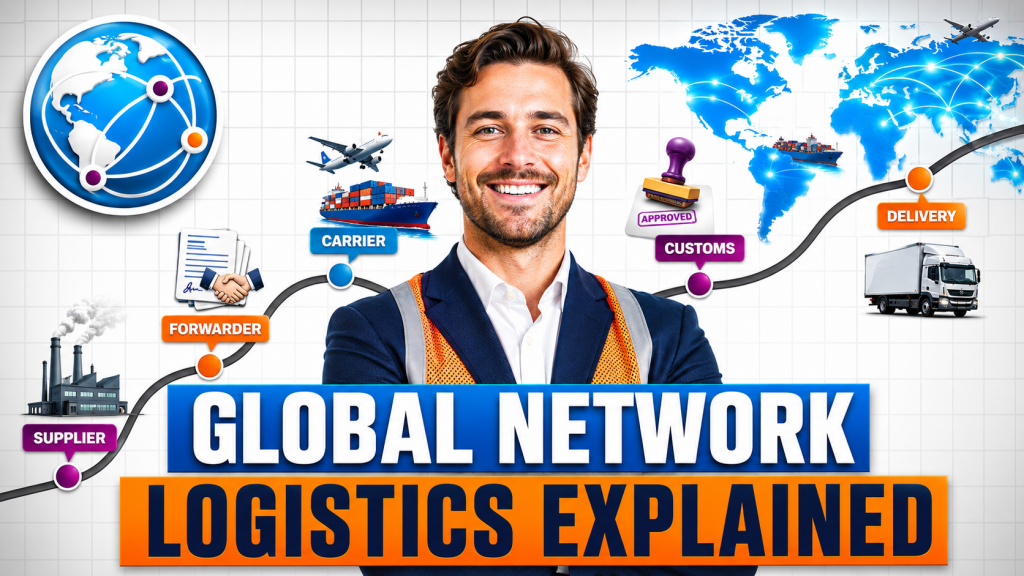
Global network logistics is the coordinated movement of goods, information and documents through an international network of suppliers, transport providers, ports, airports, warehouses, customs authorities, freight forwarders and delivery partners.
In simple terms, it is the system that connects where cargo begins with where it ultimately needs to arrive, even when those two places are separated by several countries, four transport providers and one customs officer who would like another copy of the invoice.
A global logistics network includes both physical infrastructure and commercial relationships. Ships, aircraft, roads, railways and warehouses move or store the cargo. Forwarders, agents, carriers and technology platforms coordinate the journey.
That distinction matters. A route on a map is not yet a working logistics network. Someone still needs to book it, quote it, document it, monitor it and answer the phone when the original plan decides to pursue other interests.
What Does Global Network Logistics Mean?
The phrase combines three ideas:
- Global: Activity crosses countries, customs territories and international trade lanes.
- Network: Multiple locations, routes, companies and systems are connected.
- Logistics: Goods, information and supporting documents are planned, transported, stored and delivered.
Therefore, global network logistics is not one transport mode or one company. It is the operating structure through which international cargo moves.
For a manufacturer, the network may connect suppliers, factories, regional warehouses and customers. For an independent freight forwarder, it may mean trusted overseas agents that extend service coverage beyond the company’s own offices.
ONE Globe Alliance supports that forwarding-side network. Verified freight companies can find partners, post live cargo inquiries, submit quotations, compare responses and coordinate opportunities across trade lanes through one digital platform.
The goal is active collaboration, not simply collecting company names in a directory and hoping international trade happens through positive thinking.
How a Global Logistics Network Works
A global network turns one shipment request into a series of connected activities.
Imagine a company exporting machinery from India to a customer in Kenya:
- A truck collects the cargo from the factory.
- An origin forwarder coordinates export handling and customs.
- The shipment moves through a port or consolidation warehouse.
- A shipping line carries it internationally.
- A destination agent receives the documents and arrival information.
- A customs broker coordinates import clearance.
- A local carrier delivers the machinery to the buyer.
- Tracking, documents, charges and instructions move between all parties.
That is global network logistics in action. The shipment is physical, but its success depends just as heavily on information and partner coordination.
If one link fails, the rest of the network feels it. A missing document can hold the container. A late arrival notice can delay clearance. A destination charge nobody confirmed can produce an awkward email chain with enough recipients to form a small customs committee.
The Core Parts of Global Network Logistics
1. Suppliers and manufacturers
The network begins where raw materials, components or finished goods originate. Suppliers must prepare the cargo, packing, commercial information and shipping instructions correctly.
2. Transport routes and carriers
Global cargo may move by:
- Ocean freight
- Air freight
- Road transport
- Rail freight
- Inland waterways
- A multimodal combination
Carriers physically perform the transport. The best mode depends on the cargo, route, budget, urgency and handling requirements.
3. Ports, airports and inland terminals
Gateways connect domestic transport with international carriage. Ports, airports, container freight stations, inland container depots and rail terminals handle transfer between modes.
These hubs increase network reach, but every additional handoff creates another schedule, cut-off and possible delay.
4. Warehouses and distribution centres
Warehouses store, consolidate, sort, label, repack or distribute goods. They may be positioned near factories, ports, airports or major consumer markets.
Inventory placement affects delivery time and working capital. Storing everything everywhere is very responsive. It is also an excellent way to make the finance department breathe into a paper bag.
5. Freight forwarders and overseas agents
An international forwarder designs and coordinates the shipment across carriers and borders. Its services may include routing, booking, consolidation, documents, customs coordination, tracking and destination delivery.
Because most independent forwarders do not have offices worldwide, they work with overseas agents. Those partners provide local market knowledge and handle activity at origin or destination.
6. Customs and regulatory authorities
International cargo must comply with export, import, security, licensing and product rules. Customs authorities may review declarations, collect duties and taxes, inspect cargo or request supporting documents.
The logistics network must transmit accurate information before the cargo reaches the border. Customs is not usually persuaded by the argument that the commercial invoice was “close enough.”
7. Information and technology
Modern global logistics depends on data moving between shippers, forwarders, carriers, warehouses, customs systems and customers.
Technology may support:
- Quotations and bookings
- Electronic documents
- Shipment tracking
- Customs submissions
- Warehouse inventory
- Exception alerts
- Partner communication
- Freight payments
- Performance reporting
The physical network moves freight. The digital network tells everyone what the freight is, where it should go and what has changed.
Physical Networks vs Partner Networks
“Global logistics network” can describe two connected but different structures.
| Physical logistics network | Freight partner network |
|---|---|
| Ports, airports and terminals | Origin and destination forwarders |
| Ocean, air, road and rail routes | Customs and delivery partners |
| Warehouses and distribution centres | Commercial relationships and referrals |
| Containers, vehicles and handling equipment | Inquiries, quotations and operating instructions |
| Moves and stores cargo | Extends service coverage and local expertise |
The two cannot operate effectively in isolation.
A forwarder may know the perfect ocean route but still need a reliable destination company to clear and deliver the cargo. Likewise, a partner network without operational opportunities is just a collection of introductions wearing conference lanyards.
This broader distinction is also explained in What Is a Logistics Network?.
Global Network Logistics vs Supply Chain Management
Logistics and supply chain management overlap, but they are not identical.
| Global network logistics | Supply chain management |
| Focuses on moving, storing and delivering goods | Manages the broader flow from sourcing to customer demand |
| Includes transport, warehousing, customs and tracking | Includes procurement, production, inventory, logistics and supplier strategy |
| Primarily executes product and information movement | Aligns commercial planning across the whole supply chain |
Global logistics is one part of the supply chain. Supply chain management decides what should be sourced, produced and positioned. Logistics works out how those goods will move through the network.
Or, put another way: supply chain planning draws the orchestra score. Logistics discovers the trombone is stuck at customs.
The Benefits of a Strong Global Logistics Network
Wider market coverage
Companies can serve customers in countries where they do not have their own offices, warehouses or transport assets.
More routing options
Multiple carriers, gateways and partners create alternatives when capacity tightens or a route is disrupted.
Local expertise
Destination partners understand local customs procedures, port practices, charges, transport availability and business expectations.
Better cost control
Consolidation, carrier comparisons and network planning can reduce freight and inventory costs. However, the lowest transport rate is not always the lowest total landed cost.
Faster problem solving
Strong relationships help resolve missing documents, customs questions, schedule changes and delivery exceptions more quickly.
Improved visibility
Connected systems and standardized milestones help teams see where cargo is and identify potential delays. Before opening that visibility directly to customers, forwarders should confirm the readiness points in this guide to freight tracking software and self-service updates.
Common Problems in Global Network Logistics
Too many disconnected systems
Shipment data may be spread across emails, spreadsheets, carrier portals and messaging applications. Teams spend time copying information rather than managing the shipment.
Weak partner accountability
A company profile can appear impressive while response quality remains poor. Forwarders should check references, relevant experience, communication and quotation completeness before trusting a new overseas agent.
Unclear responsibilities
The Incoterm does not replace detailed operating instructions. Origin and destination teams must still agree on charges, documents, customs roles, free time, delivery and customer communication.
Inconsistent shipment data
Different companies may describe the same milestone, commodity or charge differently. Standardized data makes automation and reporting more reliable.
Limited exception ownership
Tracking can identify a delay, but somebody must decide what to do next. A blinking red alert without an owner is simply decorative anxiety.
Network concentration
Depending too heavily on one port, carrier, country or supplier can make the network vulnerable. Alternatives should be identified before disruption occurs.
Traditional vs Digital Global Logistics Networks
Traditional networks have relied heavily on personal relationships, emails, telephone calls, conferences and agent directories. Those relationships still matter, but digital platforms can make collaboration faster and more measurable.
| Traditional network | Digital network |
| Partner discovery through referrals and events | Searchable verified member profiles |
| Inquiries sent through individual emails | Structured inquiries shared with relevant partners |
| Quotes compared manually | Quotations organized in one workflow |
| Activity depends on personal records | Platform activity creates shared visibility |
| Relationships maintained periodically | Partners can interact around live opportunities |
A digital freight network should not remove the human relationship. It should give that relationship more useful work to do.
How ONE Globe Alliance Supports Global Network Logistics
ONE Globe Alliance focuses on the partner layer of global logistics.
Through the platform, independent forwarders can:
- Discover verified companies in relevant markets
- Post cargo inquiries to other members
- Quote on international opportunities
- Compare partner responses
- Nominate suitable quotations
- Communicate directly with potential overseas agents
- Involve operations, pricing and sales colleagues
- Share achievements and build network visibility
This helps turn an overseas partner network into an active operating system rather than a static directory.
Most freight networks can introduce companies. The more valuable question is what those companies can do together after the introduction.
Forwarders can register with ONE Globe Alliance or book a platform demo.
How to Build a Better Global Logistics Network
Map the complete journey
Document every origin, transport, customs, warehouse and destination handoff. Include both physical movement and information flow.
Select partners by operational fit
Evaluate trade-lane experience, service scope, response quality, financial credibility and references. The largest partner is not automatically the best fit for every shipment.
Standardize inquiries and quotations
Use consistent cargo fields, charge categories, validity dates and exclusions. Structured information reduces misunderstandings and speeds up comparison.
Agree on responsibilities before movement
Confirm who handles documents, customs, insurance, destination charges, tracking and claims. Cargo insurance requires specific alignment, as explained in this overseas-agent cargo insurance checklist.
Measure active performance
Track response time, quote completeness, delivery performance, exception handling and claims. Directory size is a marketing number. Active reliability is an operating advantage.
Create backup routes and partners
Maintain alternatives for critical carriers, gateways and countries. Resilience is much easier to arrange before the urgent email arrives.
Frequently Asked Questions
What is global network logistics in simple terms?
Global network logistics is the system of routes, facilities, companies and technology used to move goods and information between countries.
What is a global logistics network?
A global logistics network connects suppliers, manufacturers, carriers, ports, airports, warehouses, freight forwarders, customs providers and customers across international markets.
Is global logistics the same as international shipping?
International shipping is part of global logistics. Global logistics also includes origin pickup, warehousing, customs, inventory, documentation, destination handling and final delivery.
Why do freight forwarders join global networks?
Independent forwarders join networks to find overseas partners, extend geographic coverage, exchange business opportunities and access local expertise in countries where they do not operate directly.
What technology is used in global network logistics?
Common tools include transportation management systems, warehouse systems, carrier portals, customs platforms, tracking software, electronic documents, APIs and digital freight-network platforms.
What makes a global logistics network reliable?
Reliable networks combine qualified partners, clear responsibilities, standardized data, multiple routing options, strong communication and measurable operational performance.
Final Thoughts
Global network logistics is the combination of infrastructure, companies, relationships and information that keeps international cargo moving.
The vessels and aircraft may cover the greatest distance, but the network succeeds through its handoffs: supplier to trucker, forwarder to carrier, origin agent to destination partner, customs to delivery.
The strongest global networks do more than display worldwide coverage on a map. They create clear workflows, dependable communication and practical alternatives when the first plan fails.
Because in logistics, the world is connected. Unfortunately, not everyone in the email chain is.