
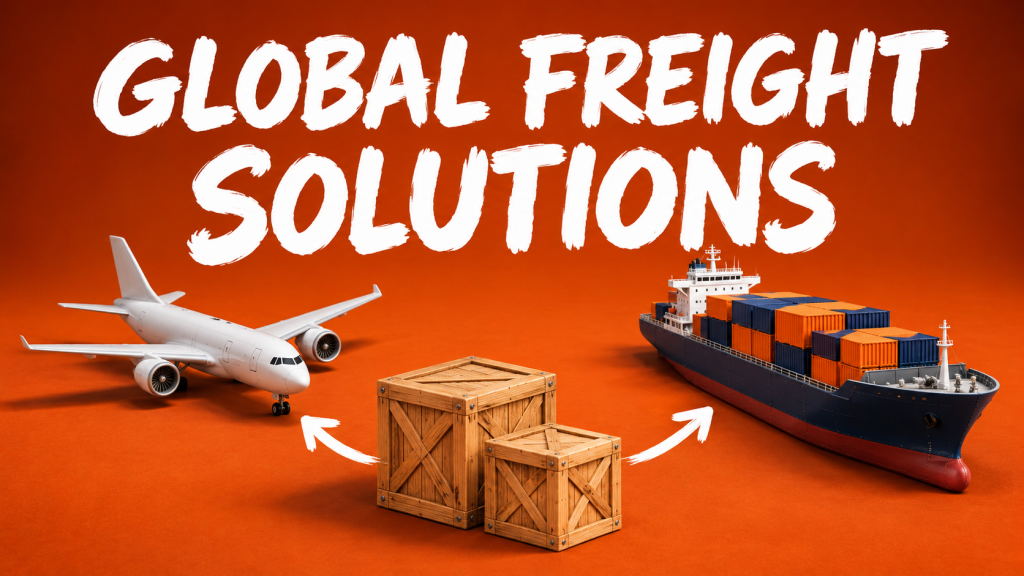
Global Freight Solutions for International Businesses: What to Book and When
A customer needs two crates by Friday. The other ten can arrive next month. Do you fly the whole order, put it all on a ship, or send it in two batches?
That’s where global freight solutions get practical. The best plan depends on what each part of the shipment needs to do for the business.
At One Globe Alliance, independent freight forwarders can post cargo enquiries, compare partner quotations, and clarify the scope directly with overseas agents. For an importer or exporter, this is the work a forwarder can coordinate on your behalf: finding a route, checking what each service includes, and making sure someone handles the cargo at the other end.
What are global freight solutions?
Global freight solutions are the transport and support services a business uses to move goods across borders. They can cover supplier pickup, air or ocean freight, customs coordination, temporary storage, and delivery to the buyer. The exact combination depends on the shipment.
If you’re new to the process, start with our guide to how global freight works. If you already have cargo to move, the choices below will help you decide what to ask for.
Which international freight solution fits your shipment?
Maersk’s guide to transport modes explains the trade-offs between air, ocean, road, and rail. Here’s how they play out when you’re choosing a service.
| Freight solution | Consider it when | Ask before booking |
|---|---|---|
| Ocean FCL (full container load) | You want a dedicated container for bulky cargo or regular replenishment | What’s the full cost, including local handling and delivery? |
| Ocean LCL (less than container load) | Your cargo can share a container and you have time for consolidation | What will origin and destination handling cost? |
| Air freight | A stockout, production stoppage, or deadline justifies the premium | What’s the chargeable weight and expected delivery date at the door? |
| Road freight | You need regional cross-border transport or the inland leg of an air or ocean shipment | Are border handling, delivery appointments, and unloading included? |
| Rail or combined transport | The route supports a suitable rail service or a mix of modes | Who coordinates transfers, and what happens if a connection is missed? |
You don’t need to fill a dedicated container to book FCL. Compare it with LCL on the same delivery scope, especially if shared-container handling charges add up. Our LCL freight quote checklist breaks down what to ask for.
Some routes also offer a combination of sea and air for the same cargo. DHL’s multimodal services show how that can work. Ask which connections the quote depends on and whether the service is available for your cargo and route.
When it makes sense to split an urgent shipment
Imagine I’m sitting with Maya, a fictional purchasing manager in Mumbai. She’s about to approve air freight for 12 crates of machine parts from Germany. I ask which parts the production team actually needs by Friday.
“Two crates,” she says, after checking with the factory.
That’s ten crates we can take off the flight. They don’t need the frequent flyer miles.
Here are three illustrative quotes, assuming comparable pickup and delivery scope for the full order:
| Plan | Freight and handling | What it solves |
|---|---|---|
| Send all 12 crates by ocean | $1,200 | Lowest quoted cost, but the two urgent crates miss the deadline |
| Fly all 12 crates | $4,200 | All crates arrive in time, assuming the delivery plan holds |
| Fly two crates and ship ten by ocean | $2,000 | The urgent parts arrive first and the rest follow |
In this example, the split saves $2,200 versus flying everything. The figures are made up and exclude duties, taxes, and insurance. Before using this approach, confirm that the split quote includes the extra pickup, handling, and paperwork where applicable. Then verify the arrival date for the two crates at the factory, where they’re actually needed.
How to compare freight quotes before you commit
Use the same start and end points. An airport-to-airport quote and a quote to the buyer’s warehouse cover different work. Ask for pickup, origin handling, main freight, destination handling, and inland delivery to be listed separately. Check currency, rate validity, and exclusions. Show duties, taxes, and insurance separately where applicable.
Compare delivery dates at the door. The World Bank’s 2025 Logistics Performance Indicators report, using 2023–24 tracking data, found that delays and unpredictability often arise at transfer hubs, ports, and inland checkpoints. Ask your forwarder how long clearance and final delivery are expected to take after arrival, and who will tell you if that estimate changes.
Confirm who is responsible for what. The International Chamber of Commerce’s Incoterms® 2020 guidance explains how the agreed rule divides certain costs, tasks, and risks between buyer and seller. Give the forwarder the rule, named place, and edition. Separately, confirm who arranges import clearance and whether cargo insurance has been booked. The International Trade Administration’s export document guide is a useful starting point for documents such as the commercial invoice, packing list, and transport document. Confirm what your route and product require before pickup.
What to send with your next freight enquiry
Give each provider the same brief so you can compare the replies:
- Route: Full pickup and delivery addresses, plus the agreed Incoterms® rule and named place.
- Cargo: Commodity, package count, packed dimensions, gross weight, and any special handling or restrictions.
- Timing: Cargo-ready date, required delivery date, and which items can arrive later if needed.
- Quote scope: Services to include, routing and timing assumptions, exclusions, and the person responsible for updates.
If you ship the same lane repeatedly, record the final invoice, actual delivery date, and any avoidable charges. After a few shipments, you’ll have a better basis for choosing between quotes than the headline freight rate alone.
Frequently asked questions
Do global freight solutions include customs clearance?
They can. Ask who will arrange export and import clearance, what brokerage fees are included, and who pays duties and taxes. Confirm those details in writing.
Is ocean freight always the cheapest option?
Ocean freight is often competitive for larger, less urgent loads. For smaller shipments, handling and delivery charges can narrow the difference. If part of the order is urgent, price a split alongside the all-air and all-ocean options.
What is the difference between a freight forwarder and a freight network?
A freight forwarder arranges the shipment services you hire them for. A freight network helps independent forwarders find partners and work with them. If you’re a forwarder building coverage on an international trade lane, book a One Globe Alliance overview and bring a sample shipment you’d like to discuss.