
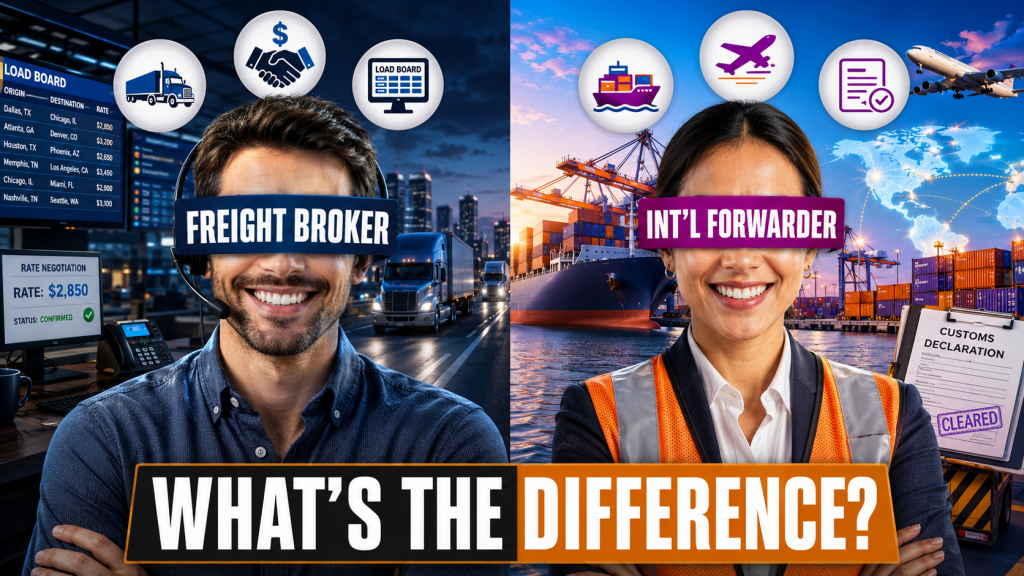
The main difference between an international forwarder and a freight broker is the scope of the job.
A freight broker primarily connects a shipper with a suitable carrier and arranges transportation. An international freight forwarder coordinates a much broader cross-border shipment, which may include pickup, consolidation, ocean or air freight, customs documentation, overseas agents, destination handling and delivery.
Both help cargo move without necessarily owning the truck, ship or aircraft. That is where the confusion starts. They both arrange transport, negotiate rates and send emails containing the phrase “please advise.” Clearly, they must be identical.
They are not.
International Forwarder vs Freight Broker: Quick Comparison
| Category | International forwarder | Freight broker |
|---|---|---|
| Main role | Coordinates an international or multimodal shipment | Connects a shipper with carrier capacity |
| Typical scope | Origin, main freight, customs coordination, destination and delivery | A defined transport movement, commonly domestic or cross-border trucking |
| Common modes | Ocean, air, road, rail and multimodal | Commonly road freight, especially FTL and LTL |
| Customs support | Often coordinates export and import customs activity | Usually outside the broker’s core role |
| Consolidation | May consolidate or deconsolidate cargo | Usually does not physically consolidate cargo |
| Documentation | Manages transport and international shipping documents | Manages booking and carrier-related paperwork |
| Overseas partners | Frequently works with destination agents | Usually relies on a carrier network rather than forwarding agents |
| Cargo possession | May take custody or arrange handling, but not always | Typically does not take possession |
| Contractual role | May act as agent, principal, carrier or NVOCC, depending on the transaction | Acts as an intermediary arranging transport |
| Best for | Cross-border, multimodal or document-heavy shipments | Straightforward capacity sourcing for a defined inland move |
The simple version is this:
A broker finds the ride. A forwarder plans the journey.
The journey may still use a broker for one part of it. Global logistics enjoys layers. Onions have layers too, but onions rarely charge detention.
What Is an International Forwarder?
An international forwarder, also called an international freight forwarder, organizes cargo movement between countries on behalf of importers, exporters and other shippers.
The forwarder coordinates the companies, information and documents required to move the shipment from origin to destination. Its services may include:
- Reviewing cargo details and shipping instructions
- Planning routes and transport modes
- Requesting rates and booking carrier capacity
- Arranging pickup and origin handling
- Consolidating LCL or air cargo
- Coordinating export and import customs clearance
- Preparing or reviewing shipping documents
- Arranging warehousing and transshipment
- Tracking milestones and managing exceptions
- Working with an overseas forwarding agent
- Coordinating destination handling and final delivery
- Arranging cargo insurance when requested
Our full guide to what an international forwarder does explains that workflow from the first shipping instruction to final delivery.
Independent forwarders rarely maintain their own office in every country. Instead, they build reliable overseas partnerships. ONE Globe Alliance helps verified freight-forwarding companies find relevant partners, post cargo inquiries, submit and compare quotations, and coordinate opportunities through a shared digital platform.
That is important because the forwarder’s job does not stop when the vessel leaves origin. Someone still needs to manage documents, charges, clearance and delivery at destination. Cargo does not become self-aware halfway across the ocean. Thankfully.
What Is a Freight Broker?
A freight broker is an intermediary that arranges transport between a shipper and a carrier.
The term is especially common in the United States trucking market. According to the U.S. Federal Motor Carrier Safety Administration, a broker arranges transportation but does not transport the property, operate the vehicles or assume responsibility for the cargo in the same way as the motor carrier.
A freight broker typically:
- Receives a load requirement from the shipper
- Searches its carrier network for suitable capacity
- Checks carrier authority and basic compliance information
- Negotiates the carrier rate
- Confirms pickup and delivery appointments
- Shares instructions between shipper and carrier
- Tracks the road shipment
- Helps communicate when delays occur
- Manages commercial payment between the parties
The broker’s strength is access to capacity. A shipper does not need to maintain relationships with hundreds of trucking companies just to cover changing routes, equipment types or seasonal demand.
The broker finds a carrier that can perform the move. It does not usually provide the wider international forwarding process around that move.
The Most Important Differences
1. A broker arranges a movement; a forwarder coordinates a shipment
A broker is generally hired to secure transportation for a defined route, such as moving 18 pallets from a factory in Ohio to a distribution centre in Texas.
An international forwarder may coordinate a shipment from a supplier in Pune to a buyer in Rotterdam. That could involve:
- Trucking from the supplier to an origin warehouse
- Export customs clearance
- Container loading or consolidation
- Ocean freight
- Destination deconsolidation
- Import customs coordination
- Final delivery
The forwarder is joining several services into one operational plan. The broker is usually solving the capacity requirement for one transport leg.
2. International forwarders work across borders and modes
Freight brokers are strongly associated with domestic and cross-border trucking, especially FTL and LTL freight in North America.
International forwarders regularly coordinate ocean, air, road and rail services. They may combine multiple modes within the same shipment and manage the handoffs between carriers, terminals, warehouses and local agents.
Geography alone is not a perfect legal test. A broker can arrange a cross-border truck movement, and a forwarder can manage domestic freight. The difference is better understood through the service scope, contractual role and authority under which the company operates.
3. A forwarder handles more international documentation
An international shipment may involve:
- Commercial invoice
- Packing list
- Bill of lading or air waybill
- Certificate of origin
- Export declaration
- Import permits
- Dangerous-goods declaration
- Insurance certificate
- Customs and product-compliance documents
The forwarder coordinates these documents and checks that the shipment instructions align across the transport chain.
A freight broker still deals with transport paperwork, rate confirmations, pickup references and delivery records. However, international commercial and customs documentation is not usually the centre of the brokerage service.
4. Forwarders may consolidate cargo
International forwarders may combine several smaller shipments into one larger ocean or air movement. This allows shippers to buy only the capacity they require.
For example, an LCL forwarder can receive cargo from several exporters, coordinate loading into one container and arrange deconsolidation at destination. The LCL freight quote checklist explains why origin, freight and destination charges must all be aligned before quoting.
A broker usually does not receive, pack or consolidate cargo. It finds a carrier to perform the agreed transport movement.
5. Their overseas networks work differently
A forwarder may require an origin agent, destination agent, customs broker, consolidator and delivery provider. The quality of those relationships directly affects the customer’s shipment.
A freight broker mainly develops a carrier network. Its priority is finding qualified equipment and capacity for particular routes.
Both depend on networks, but they use those networks for different purposes:
- Broker network: carriers and available transport capacity
- Forwarder network: carriers, overseas agents, customs specialists, warehouses and trade-lane partners
This is why a digital logistics network can be valuable for independent forwarders. It turns overseas relationships into an active workflow for inquiries, quotations and partner communication.
6. Responsibility and liability are more nuanced than most comparisons suggest
Many articles say a broker has no cargo responsibility while a forwarder always takes possession and becomes fully liable. That explanation is tidy, but international forwarding is rarely that tidy.
A freight broker normally acts as the intermediary arranging transport. The performing carrier remains responsible for carriage under its contract and applicable law. However, a broker may still face responsibility for its own negligence, representations, contractual commitments or carrier-selection practices, depending on the facts and jurisdiction.
An international forwarder’s role can also change from shipment to shipment. It may act:
- As the shipper’s agent when arranging carrier services
- As a principal contracting to provide the transport
- As a contractual carrier when issuing its own transport document
- As an NVOCC for ocean freight, where applicable
- In different capacities for different legs of one shipment
Physical possession is therefore not the only test. A forwarder can arrange cargo handling through subcontractors without personally placing the box into a warehouse.
Before booking, ask:
- Whose transport document will be issued?
- Is the provider acting as agent or principal?
- Which standard trading conditions apply?
- Who is the contractual carrier?
- Which party receives a cargo claim?
- What insurance has been arranged?
If the answer is “don’t worry, sir,” worry a little more.
International Forwarder vs Freight Broker: Example Shipments
Example 1: Domestic truckload
A manufacturer needs one full truckload moved from Chicago to Atlanta. The cargo is ready, no border is involved and the main challenge is finding a suitable truck at a competitive rate.
Likely choice: Freight broker.
The broker can source a carrier, negotiate the rate and coordinate pickup and delivery.
Example 2: LCL shipment from India to South Africa
An exporter needs four pallets collected in Ahmedabad, consolidated at origin, shipped by sea, cleared in Durban and delivered to the buyer.
Likely choice: International freight forwarder.
The shipment involves export activity, LCL consolidation, ocean documents, an overseas agent, destination charges, customs coordination and delivery.
Example 3: Air freight with urgent final delivery
A time-critical machinery part must move from Germany to the United States. The shipment requires air freight, import clearance and an expedited truck after arrival.
Likely choice: International forwarder, potentially using a broker for the U.S. trucking leg.
The forwarder manages the international shipment while a broker may help secure urgent inland capacity.
Can You Use Both a Freight Forwarder and a Freight Broker?
Yes. Many international shipments use both.
Consider a container moving from a factory in Vietnam to a consignee in the United States:
- The international forwarder arranges origin collection, export handling, ocean freight, documents and destination coordination.
- A customs broker may submit the import entry.
- A freight broker may find a trucker for the final container delivery.
- The motor carrier physically performs that inland movement.
The customer may communicate only with the forwarder, but several specialist providers can be working behind the scenes.
This is normal. The critical issue is whether responsibilities, charges and communication are clearly assigned before the cargo moves.
Which One Should You Choose?
Choose a freight broker when:
- You primarily need domestic truck capacity
- The pickup and delivery requirements are already defined
- No customs or international documentation is required
- You need access to multiple carriers without contracting each one directly
- Demand changes frequently across lanes or equipment types
Choose an international forwarder when:
- Cargo is crossing international borders
- The shipment uses ocean or air freight
- Several transport modes or handoffs are involved
- You need consolidation or deconsolidation
- Export and import documents must be coordinated
- You need an overseas agent
- Origin, destination and delivery charges must be managed together
Use both when an international shipment also requires flexible inland trucking capacity.
Questions to Ask Before Hiring Either Provider
Ask an international forwarder about its trade-lane experience, overseas agent, contractual role, transport documents, customs-clearance scope, destination charges and exception process.
Ask a freight broker about its authority, carrier-vetting process, re-brokering policy, tracking, cargo-insurance verification and responsibility for missed pickups or accessorial charges.
Whichever provider you choose, confirm who receives a loss or damage claim. For international shipments, use this cargo insurance checklist for overseas-agent alignment. Freight liability and cargo insurance are not the same thing, despite both appearing whenever someone says, “Surely this is covered?”
How ONE Globe Alliance Fits into the Forwarding Side
ONE Globe Alliance is designed for international freight forwarders rather than domestic load brokerage.
Verified members can use the platform to:
- Find forwarding partners in relevant countries
- Post live cargo inquiries
- Quote on opportunities from other members
- Compare quotations
- Communicate with potential overseas agents
- Coordinate activity across operations, pricing and sales teams
- Build visibility through active participation
Most forwarders do not need another static list of company names. They need dependable partners who can respond to actual shipment opportunities and handle cargo properly at the other end.
Forwarders can register with ONE Globe Alliance or book a platform demonstration.
Frequently Asked Questions
Is a freight forwarder the same as a freight broker?
No. A freight broker mainly arranges transportation between a shipper and carrier. A freight forwarder coordinates a broader shipment and may handle consolidation, international documents, customs activity and overseas-agent handoffs.
Does a freight broker physically handle cargo?
Typically, no. A broker arranges transport but does not take possession of the freight. The selected motor carrier physically transports it.
Does an international forwarder own ships or aircraft?
Usually not. Forwarders purchase or arrange capacity with shipping lines, airlines, truckers and rail providers. Some forwarders own trucks or warehouses, but asset ownership is not what defines the service.
Is a freight broker only used for domestic shipping?
Not exclusively. Brokers can arrange cross-border trucking and other movements permitted by their authority. However, the term is most strongly associated with domestic road-freight capacity, particularly in North America.
Can a freight forwarder arrange trucking?
Yes. International forwarders routinely arrange collection and final delivery. They may contract a motor carrier directly or use a freight broker to find capacity.
Who handles customs clearance?
An international forwarder often coordinates customs clearance directly or through a licensed customs broker. A freight broker does not normally provide customs clearance as part of standard domestic brokerage.
Who is liable if cargo is damaged?
The answer depends on the contracts, transport documents, applicable law and the capacity in which each provider acted. Do not rely only on labels such as “broker” or “forwarder.” Confirm the contractual carrier, claim process and insurance before shipping.
Final Answer: Forwarder or Broker?
The choice between an international forwarder and a freight broker depends on the problem you need solved.
A freight broker is usually the right fit when you need qualified carrier capacity for a defined inland movement. An international forwarder is the better fit when cargo crosses borders and requires several transport services, documents and overseas partners to operate as one shipment.
One finds the truck. The other designs the international journey. Sometimes they work together, because global logistics is a team sport played by people who communicate mainly through attachment-heavy emails.
Choose based on scope, authority and contractual responsibility, not simply the name printed below the company logo.