TL;DR: Nearshoring to Mexico isn’t a future trend—it’s a present-day gold rush that most independent forwarders are watching from the sidelines. With Mexico becoming the #1 US trade partner in 2023 (surpassing China for the first time in 20 years), over $800 billion in annual cross-border goods, and 500+ manufacturing relocations since 2023, the revenue gap is widening daily. Forwarders who establish Monterrey, Guadalajara, and Querétaro coverage in 2026 will own these trade lanes through 2030. Those who wait will spend the next decade quoting against competitors who moved first.
The Data: Why Mexico Became the #1 US Trade Partner
We need to stop calling nearshoring to Mexico a “trend.” It’s a structural economic shift, and the numbers confirm it’s already happened.
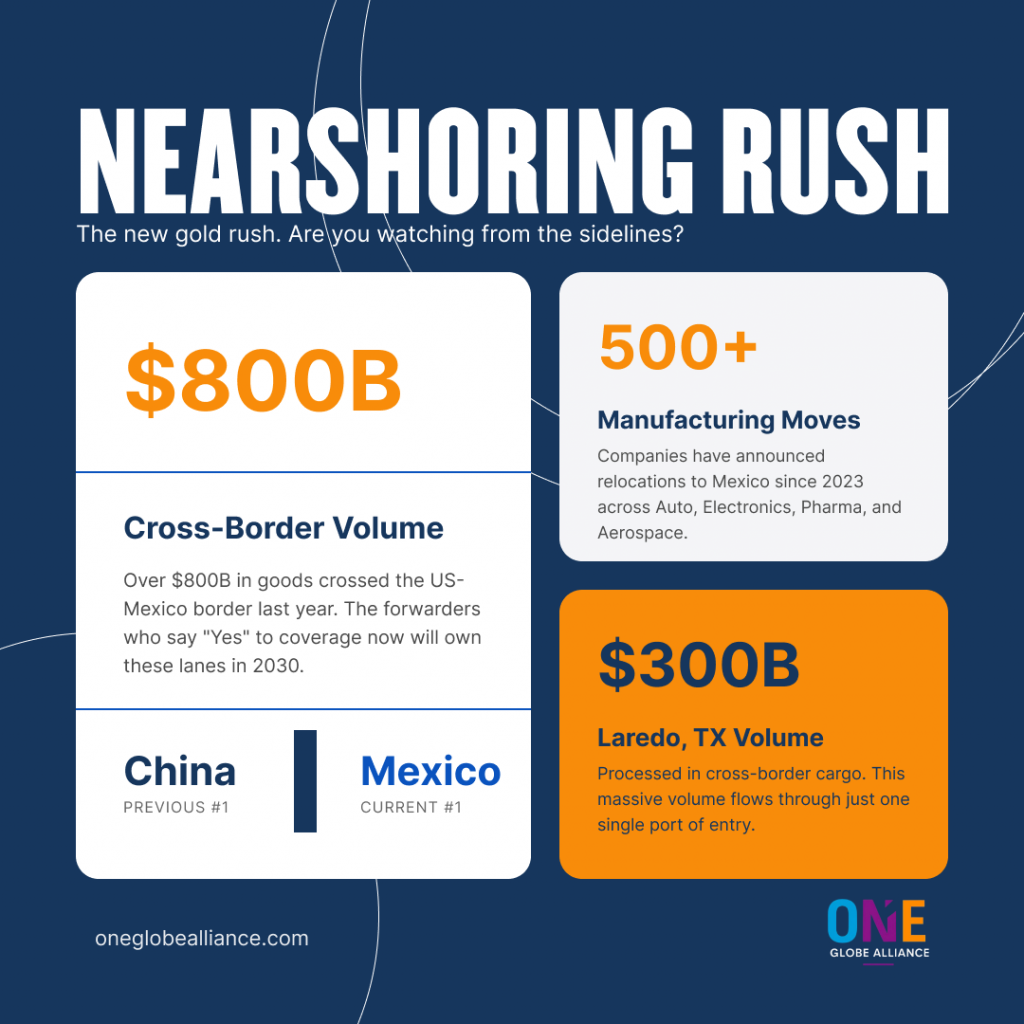
The watershed moment: Mexico became the #1 US trade partner in 2023—the first time in 20 years. China is no longer #1.
The volume: Over $800 billion in goods crossed the US-Mexico border last year. To put that in perspective, Laredo, Texas alone—one port of entry—processed over $300 billion in cross-border cargo.
Key Insight: This isn’t a future problem to solve. It’s a current revenue gap that’s widening every week your competitors establish Mexico coverage while you wait.
The Manufacturing Migration: 500+ Relocations and Counting
Since 2023, 500+ companies have announced manufacturing relocations to Mexico. This isn’t speculative capacity planning—these are active facility builds and production line transfers.
Industries Leading the Migration:
- Automotive: EV and component manufacturing clustering in Monterrey and Bajío regions
- Electronics: Consumer electronics and semiconductor packaging moving from Asia
- Pharma: API (Active Pharmaceutical Ingredient) production and medical device manufacturing
- Aerospace: Precision manufacturing and MRO (Maintenance, Repair, Overhaul) operations
Every week, your existing clients are moving production to Monterrey, Guadalajara, and Querétaro. And they’re asking their freight partners one question: “Do you have coverage there?”
The Critical Geography: Where the Volume Is Concentrating
Not all Mexico logistics corridors are created equal. The nearshoring boom is concentrating in specific industrial hubs that require dedicated freight forwarding infrastructure.
Monterrey (Nuevo León)
The industrial capital of northern Mexico. Primary hub for automotive, appliances, and heavy manufacturing. Direct highway corridor to Laredo, Texas (2.5-hour drive). Critical for just-in-time manufacturing supply chains.
Guadalajara (Jalisco)
Electronics and high-tech manufacturing center. “Mexico’s Silicon Valley” for semiconductor testing and packaging. Strong air freight demand for time-sensitive tech components.
Querétaro (Querétaro)
Aerospace precision manufacturing and automotive components. High-value cargo requiring specialized handling and security protocols.
The Question: Can you answer “Yes” when clients ask if you have established agent partnerships, warehousing, and customs brokerage capabilities in these three cities?
The Window: Why Trade Lanes Consolidate Fast, Quietly, and Permanently
This is how trade lanes consolidate: Fast. Quietly. Permanently.
When a shipper relocates production to Monterrey and asks their forwarder about Mexico coverage:
- The forwarder who answers “Yes, we have a vetted partner in San Pedro Garza García and regular Laredo crossing capacity” secures the lane immediately.
- The forwarder who answers “Let me get back to you” loses not just that shipment, but the entire account relationship as production scales.
By 2030, the forwarders who moved in 2026 will have embedded relationships with Mexico agents, established customs broker networks, and dedicated Laredo/Nogales/LA-Mexico corridor capacity. The late entrants will spend the next decade quoting against incumbents who control the lane capacity.
The window is open. Windows don’t stay open forever.
Key Takeaways: What You Need to Know
- 🔹 The #1 Trade Partner Shift: Mexico overtook China as the top US trade partner in 2023—a structural change, not a temporary spike
- 🔹 The Volume Reality: $800B+ annual cross-border trade with $300B+ through Laredo alone creates unprecedented forwarding demand
- 🔹 The Industry Mix: Automotive, electronics, pharma, and aerospace are actively relocating production—high-value, regular-volume cargo
- 🔹 The Hub Geography: Monterrey, Guadalajara, and Querétaro are the primary nearshoring destinations requiring dedicated coverage
- 🔹 The Consolidation Dynamic: First-mover forwarders in 2026 will own these lanes through 2030; late entrants face permanent competitive disadvantage
Frequently Asked Questions
What is nearshoring to Mexico?
Nearshoring to Mexico is the strategic relocation of manufacturing operations from Asia (primarily China) to Mexico to reduce supply chain lead times, minimize geopolitical risk, and leverage the USMCA trade agreement. It creates demand for cross-border freight forwarding, customs brokerage, and Mexico-US logistics corridors.
Why is Mexico now the #1 US trade partner?
Mexico became the #1 US trade partner in 2023 for the first time in 20 years due to the convergence of USMCA tariff advantages, pandemic-exposed supply chain vulnerabilities in Asia, rising China labor costs, and geopolitical risk mitigation strategies. Over $800 billion in goods now cross the US-Mexico border annually.
Which industries are relocating to Mexico?
The primary industries nearshoring to Mexico since 2023 include automotive (EV and component manufacturing), electronics (semiconductor packaging and consumer tech), pharmaceuticals (API production and medical devices), and aerospace (precision manufacturing and MRO operations).
What are the main manufacturing hubs in Mexico for freight forwarders?
The three critical nearshoring hubs are: Monterrey (automotive/heavy manufacturing, Laredo corridor access), Guadalajara (electronics/high-tech, air freight intensive), and Querétaro (aerospace/automotive components, high-value cargo).
Why is Laredo, Texas important for freight forwarders?
Laredo, Texas is the single largest land port in the Western Hemisphere, processing over $300 billion in cross-border cargo annually. It serves as the primary US entry point for Monterrey and northern Mexico manufacturing, making it essential for any forwarder serious about nearshoring logistics.
How long is the window open for establishing Mexico coverage?
The window for competitive entry is closing in 2026. Trade lanes consolidate rapidly as manufacturers lock in logistics partnerships during facility ramp-up phases. Forwarders who don’t establish Mexico agent networks and Laredo corridor capacity by 2026 will face 10 years of quoting against entrenched competitors who secured lane control early.
Implementation Checklist: Your 90-Day Mexico Entry Plan
- [ ] Week 1-2: Vet and establish agent partnerships in Monterrey, Guadalajara, and Querétaro (verify USMCA compliance expertise)
- [ ] Week 3-4: Secure Laredo, TX border crossing capacity and customs broker relationships (critical for Monterrey volume)
- [ ] Week 5-6: Develop Nogales, AZ alternative corridor option (secondary border for Guadalajara/Tijuana lanes)
- [ ] Week 7-8: Create Mexico-specific rate cards for automotive/electronics/pharma verticals (high-volume nearshoring sectors)
- [ ] Week 9-10: Train sales teams on “Yes, we have Mexico coverage” positioning and specific hub capabilities
- [ ] Week 11-12: Launch client outreach campaign targeting existing accounts with known Mexico relocation plans
- [ ] Ongoing: Monitor 500+ company relocation announcements for new facility openings in your client’s supply chains
The Bottom Line
Nearshoring to Mexico isn’t a trend anymore. It’s a gold rush. And most independent forwarders are still watching it happen from the sidelines.
Where does your Mexico network stand today? Can you answer “Yes” when clients ask about Monterrey coverage? Or are you still saying “Let me get back to you”?
Drop your current Mexico capabilities in the comments—let’s see who’s positioned to own these lanes in 2030.