TL;DR: The Strait of Hormuz is effectively closed. IRGC officials threaten to “set fire to any ship” attempting transit. ~3,200 vessels are idle inside the Persian Gulf, 500 ships queue off UAE/Oman, and Gulf airspace (UAE, Qatar, Bahrain, Kuwait, Iraq, Iran) is blacked out. Air freight rates are climbing, Maersk confirms Cape of Good Hope rerouting (adding 10-14 days), and force majeure clauses are activating. If your trade lane touches the Gulf, Red Sea, or Suez, you are already inside this disruption.
The Current Crisis: When Maps Show a Black Void
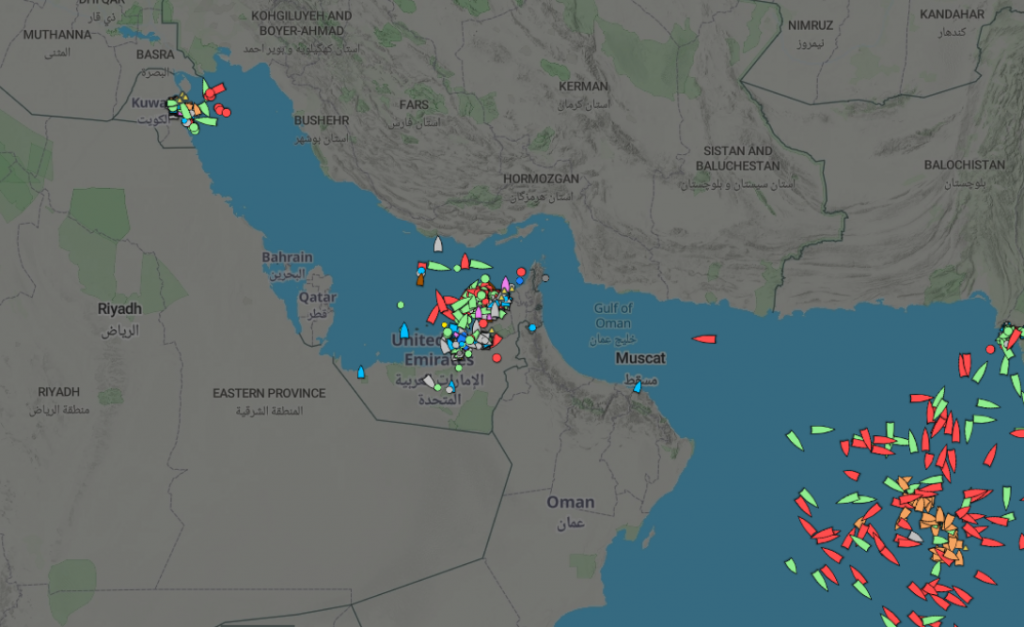
Two maps from the same week reveal different realities.
Flightradar24 Map: Iran, Iraq, Kuwait, Bahrain, Qatar, UAE. A black void.
Maritime Map: A cluster of ships sitting east of Oman—not anchoring for layover, but waiting to see if the Strait of Hormuz reopens.
This is not a glitch. This is your airfreight corridor and primary maritime chokepoint. Gone.
The Official Warning
Iran has officially stated: “No ship is allowed to pass.” An IRGC senior official added he would “set fire to any ship” attempting transit. This is not posturing. This is your force majeure clause activating in real time.
Key Insight: The supply chain works like a long train. One derailed car doesn’t just stop that car—it stops every car behind it. The Gulf car is derailed.
Crisis Data: No Noise, Just Numbers
→ ~3,200 vessels currently idle inside the Persian Gulf (Clarksons Research)
→ ~500 ships queued just outside, waiting off UAE and Oman
→ Airspace closed: UAE, Qatar, Bahrain, Kuwait, Iraq & Iran
→ Cargo ops grounded: Emirates, Qatar Airways, Etihad
→ Ocean rerouting: Maersk officially announced Cape of Good Hope rerouting (again)
→ Air freight rates: Already climbing—confirmed by Maersk in writing
→ Brent Crude: Jumped from ~$70 to over $80/barrel within days
Trade Lane Impact Analysis: What This Means by Mode
Air Freight: Capacity Crushed, Rates Surging
High-value, time-sensitive cargo—pharmaceuticals, electronics, perishables—faces immediate capacity constraints. With UAE and Doha hubs offline, alternate routing is required now.
Immediate Impacts:
- Capacity wars emerging on every lane that transited Gulf hubs
- Surcharges applying to rerouted air cargo via European or Asian hubs
- Transit time extensions of 2-5 days minimum for redirected flights
Action Required: Audit all air freight contracts with fixed transit times. Identify alternative routings via Istanbul, European gateways, or direct Asian-European lanes immediately.
Ocean Freight: Cape Route Adds 10-14 Days Minimum
With the Strait of Hormuz effectively closed, Cape of Good Hope routing becomes mandatory for Gulf-origin or destined cargo.
Operational Realities:
- Transit time: Additional 10-14 days minimum
- War risk surcharges: Live and escalating
- Contract exposure: Fixed transit time clauses are now unenforceable without amendment
Critical Alert: If your contracts contain fixed transit time clauses, call your clients before they call you. Proactive communication is the only way to maintain trust during force majeure events.
Cargo-Specific Disruptions: Beyond Oil
It’s not only oil moving through here. The Hormuz closure cascades across multiple verticals:
Pharmaceuticals (India exports): Delayed. Critical temperature-controlled generics and API shipments face air capacity constraints.
Semiconductors (Asia flows): Delayed. Just-in-time manufacturing chains for automotive and electronics face component shortages.
Petrochemical feedstock: Your plastic, your rubber. Delayed. Manufacturing inputs for packaging, automotive, and consumer goods face extended lead times.
Nitrogen fertilizer (Gulf origin): Delayed. Agricultural supply chains face planting season disruptions.
If your trade lane touches the Gulf, the Red Sea, or Suez in any way, you are already inside this disruption.
Gulf Agents: Operational Status Check
Gulf-based logistics partners face existential operational constraints.
Immediate Action: If you haven’t confirmed their operational status in the last 48 hours—pick up the phone right now.
- Confirm their ability to receive/store/export cargo
- Verify alternative routing capabilities via Oman or Jordanian corridors
- Validate their force majeure declarations and insurance coverage
Key Takeaways: Critical Actions for Logistics Managers
- 🔹 Accept Reality: ~3,200 vessels idle and 500 queued means this is not a 48-hour disruption. Plan for weeks, not days.
- 🔹 Air Crisis Mode: Gulf hub closures (DXB, DOH) crush capacity. Secure alternative routings immediately for high-value/time-sensitive cargo.
- 🔹 Ocean Rerouting: Cape of Good Hope adds 10-14 days. Communicate this to clients with fixed transit contracts immediately.
- 🔹 Commodity Exposure: Pharma, semiconductors, petrochemicals, and fertilizer face immediate delays. Check inventory buffers.
- 🔹 Agent Verification: Confirm Gulf partner operational status within 48 hours or assume non-availability.
- 🔹 Cost Management: Brent crude at $80+ means fuel surcharges are incoming. Audit BAF clauses now.
Frequently Asked Questions
What is the Strait of Hormuz supply chain disruption?
The Strait of Hormuz supply chain disruption is an active crisis where Iran has effectively closed the critical maritime chokepoint (handling ~20% of global oil and significant container traffic) and adjacent airspace, forcing vessel idling, air freight groundings, and mandatory Cape of Good Hope rerouting.
How many ships are affected by the Hormuz closure?
According to Clarksons Research, approximately 3,200 vessels are currently idle inside the Persian Gulf, with an additional ~500 ships queued outside waiting off UAE and Oman for potential reopening.
Which airspaces are closed in the Gulf crisis?
Airspace closures include UAE, Qatar, Bahrain, Kuwait, Iraq, and Iran. Major cargo carriers Emirates, Qatar Airways, and Etihad have grounded operations, eliminating primary air freight hubs for Europe-Asia and Gulf-Global traffic.
How long does Cape of Good Hope routing add to transit times?
Rerouting via the Cape of Good Hope (avoiding Suez and Gulf constraints) adds approximately 10-14 days to standard transit times for Asia-Europe or Gulf-Global lanes, plus additional war risk surcharges and fuel costs.
What cargo is most affected by the Hormuz disruption?
Beyond oil and LNG, critical affected commodities include: pharmaceuticals (Indian exports), semiconductors (Asian transhipments), petrochemical feedstocks (plastics/rubber manufacturing inputs), and nitrogen fertilizers (agricultural supply chains).
What should freight forwarders do immediately?
- Confirm Gulf agent operational status within 48 hours
- Communicate Cape of Good Hope delays to clients with fixed transit contracts
- Secure alternative air freight routings (via Istanbul/Europe) for high-value cargo
- Audit force majeure and war risk clauses in current contracts
- Review inventory buffers for pharma/electronics/petrochemical clients
48-Hour Crisis Checklist for Logistics Teams
- [ ] Hour 0-4: Confirm operational status of all Gulf-based agents/partners (UAE, Bahrain, Qatar, Kuwait)
- [ ] Hour 4-8: Identify all shipments currently in transit via DXB/DOH air hubs—reroute via alternate corridors
- [ ] Hour 8-12: Client communication blast for all fixed-transit-time contracts regarding Cape of Good Hope delays (+10-14 days)
- [ ] Hour 12-24: Audit war risk insurance and force majeure clause applicability for current bookings
- [ ] Hour 24-48: Review fuel surcharge (BAF) clauses in contracts given Brent crude jump to $80+
- [ ] Ongoing: Monitor Clarksons vessel count data for queue reduction (indicator of reopening timeline)
The Bottom Line
The Strait of Hormuz closure is not a regional inconvenience—it is a global supply chain seismic event. With air corridors blacked out and maritime traffic at a standstill, every trade lane touching the Gulf faces immediate constraint.
What’s your biggest exposure right now? Air? Ocean? A specific trade lane? Drop it in the comments below—our network is monitoring this in real-time and sharing live intelligence.