
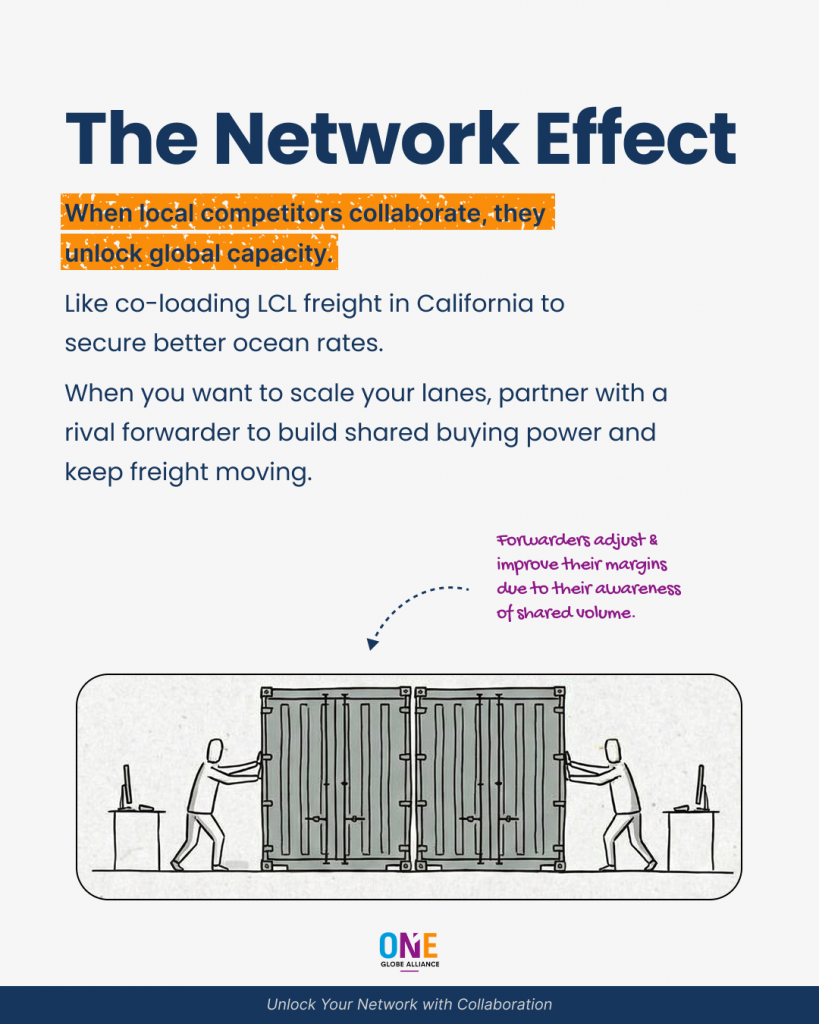
TL;DR: Chasing new shippers isn’t the only growth strategy—freight forwarder collaboration with local competitors unlocks co-loading economies, better carrier buying power, and guaranteed allocations during blank sailings. Independent forwarders moving volume from California, New Jersey, Texas, or Illinois can transform fierce local rivals into global network partners, accessing lanes neither could profitably service alone.
The Local Market Trap: When Competition Becomes Cannibalization
Unlocking growth doesn’t always mean hunting for new shippers. Sometimes, the key is sitting in an office right across the street.
We all fight for the same freight in our local markets. Whether you’re moving boxes out of California, New Jersey, Texas, or Illinois—it’s fiercely competitive. But when independent forwarders view every local competitor as an enemy, everyone pays a premium and fights for scraps.
Key Insight: Your local competitor doesn’t have to be your enemy. They can be the ultimate partner in your network.
The most successful independent forwarders aren’t building walls around their backyard—they’re building bridges across the street.
The Collaboration Economics: Why Co-Loading Changes Everything
Think about the missed opportunities. You have LCL (Less than Container Load) volume moving into Rotterdam. Your competitor across town has a few pallets heading to the exact same CFS (Container Freight Station).
If you block each other out: You both pay premium rates for partial container space. You both struggle for carrier attention. You both miss allocations when capacity tightens.
If you unlock collaboration: Everything changes.
1. Co-Load to Consolidate Buying Power
When you combine LCL volumes with local competitors, you create FCL (Full Container Load) economics out of partial shipments. Instead of paying inflated LCL rates to consolidators, you become the consolidator.
The Math:
- Individual LCL shipments: High per-CBM rates, handling fees at destination CFS
- Collaborative co-load: FCL rate divided proportionally, direct delivery options, volume discounts
Result: Both parties retain margin while offering competitive rates to their respective clients.
2. Secure Allocations When Capacity Tightens
Blank sailings and vessel rollovers devastate small volume shippers. But carriers prioritize partners who deliver consistent, aggregated volume.
When you collaborate locally, you present combined weekly volume to steamship lines. This transforms you from a sporadic booker into a strategic account—unlocking:
- Guaranteed space allocations during peak season
- Priority loading when rollovers occur
- Favorable contract terms based on consolidated TEU commitments
3. Unlock Lanes You Couldn’t Service Alone
Collaboration unlocks lanes you couldn’t profitably service alone. That niche trade lane your client keeps asking about—the one where you have occasional volume but not enough to justify direct contracts—becomes viable when combined with your competitor’s similar volume.
Real Example: Forwarder A has monthly medical equipment exports to Warsaw. Forwarder B has sporadic machinery parts to the same region. Combined, they sustain a regular consolidation service neither could justify independently.
Key Takeaways: Collaboration Over Competition
- 🔹 Stop Fighting for Scraps: Local markets become premium battlegrounds when forwarders refuse collaboration, driving up costs for everyone
- 🔹 Co-Loading Economics: Combining LCL volumes creates FCL buying power and eliminates unnecessary handling fees
- 🔹 Carrier Leverage: Aggregated volume across local competitors secures allocations during blank sailings and peak capacity crunches
- 🔹 Lane Viability: Collaboration makes niche lanes profitable by combining sporadic volumes into consistent service offerings
- 🔹 Network Effects: Independent forwarders who build bridges, not walls, access global reach impossible to achieve in isolation
Frequently Asked Questions
What is freight forwarder collaboration?
Freight forwarder collaboration is a strategic partnership where independent logistics companies combine shipment volumes, share carrier contracts, or coordinate co-loading to achieve economies of scale and service capabilities that would be impossible individually. It transforms local competitors into network partners.
How does co-loading work between freight forwarders?
Co-loading occurs when two or more forwarders combine their Less than Container Load (LCL) shipments into a single Full Container Load (FCL). Each forwarder pays only for their proportional space while benefiting from FCL rates and direct routing. The container is stripped at destination by mutual agreement or designated partner.
Is it risky to collaborate with local competitors?
Risk exists without proper structure, but collaboration agreements typically include:
- Non-compete clauses on direct clients (you bring your clients, they bring theirs)
- Clear volume commitments and space allocation formulas
- Defined financial settlements and credit terms
- Confidentiality agreements protecting client data
Structured collaboration reduces risk while increasing both parties’ market competitiveness.
How do I start collaborating with local freight forwarders?
Start with complementary, non-conflicting volume. Identify competitors moving similar commodities to the same destinations—medical devices to Europe, apparel to Southeast Asia, automotive parts to specific regions. Propose a trial co-load on one lane with transparent cost-sharing before expanding to broader partnerships.
What are the benefits of independent freight forwarder networks?
Independent forwarder networks provide global reach without corporate overhead. Members maintain local autonomy while accessing:
- Co-loading opportunities across regions
- Shared carrier contracts with better rates
- Local expertise in destination markets
- Backup capacity during disruptions
- Referral revenues for out-of-scope inquiries
Implementation Checklist: Your 60-Day Collaboration Launch
- [ ] Week 1: Map current LCL volumes by destination—identify where you’re paying high consolidation rates
- [ ] Week 2: Research local competitors (same state/region) with complementary volume patterns (different shippers, similar destinations)
- [ ] Week 3: Initiate exploratory conversations focusing on specific lanes (e.g., “We both move volume to Rotterdam—could we co-load?”)
- [ ] Week 4: Draft collaboration agreement covering client confidentiality, volume commitments, and cost-sharing formulas
- [ ] Week 5: Execute trial co-load (single container) to test operational compatibility and documentation workflows
- [ ] Week 6-8: Evaluate trial results, adjust processes, and formalize ongoing collaboration terms
- [ ] Ongoing: Quarterly volume reviews to identify new co-loading opportunities and expand to additional trade lanes
The Bottom Line
Stop guarding your backyard so closely that you miss out on the global network.
The most successful independent forwarders are the ones building bridges, not walls. When local collaboration replaces cutthroat competition, you transform from a small player fighting for scraps into a network node with global reach and carrier clout.
Who is a local competitor you’ve successfully partnered with? Tag them below—celebrate the collaboration mindset that drives this industry forward.