
Freight Forwarding Automation: Why Human Expertise Still Wins (And How AI Helps)
TL;DR: Automation isn’t replacing freight forwarders—it’s eliminating manual data entry and reactive firefighting so humans can focus on relationship building and crisis negotiation. Digital tools boost workforce productivity by 20% and cut operational costs by 30%, but algorithms can’t calm stressed shippers or navigate carrier rollings. The winning formula: Let systems handle data; let humans handle trust.
The Fear: Is Automation Coming for Freight Forwarding Jobs?
We keep hearing this fear across the freight forwarding industry: “Automation is coming for our ops jobs.”
Let’s get one thing straight: AI doesn’t negotiate with a carrier when a vessel gets rolled. An API doesn’t calm down a stressed shipper whose cargo is stuck in customs. Algorithms don’t build relationships—humans do.
The narrative that digital tools will replace logistics professionals misses the fundamental reality of freight forwarding. This is a relationship business built on trust, negotiation, and creative problem-solving during exceptions. These are irreplaceably human skills.
Key Insight: Technology doesn’t replace forwarders. It gives forwarders superpowers by removing the “grunt work” so teams can focus on the “growth work.”
The Shift: From Grunt Work to Growth Work
When dispatchers spend mental bandwidth thinking “I have to manually enter this eBL” instead of “Let me optimize this routing,” the business loses competitive advantage. When operations teams ask “Where is that container?” instead of “Let me proactively update the client,” service quality degrades.
Freight forwarding automation creates a division of labor that plays to respective strengths:
- Systems handle: Data entry, tracking, document processing, rate calculations
- Humans handle: Negotiation, relationship management, crisis intervention, strategic optimization
This reallocation doesn’t shrink headcount—it amplifies impact. Research shows companies implementing logistics technology achieve workforce productivity increases of up to 20%, while digitalizing supply chains can reduce operational costs by up to 30%.
3 Ways Digital Tools Supercharge Logistics Operations
1. Eliminate the “Paper Chase”
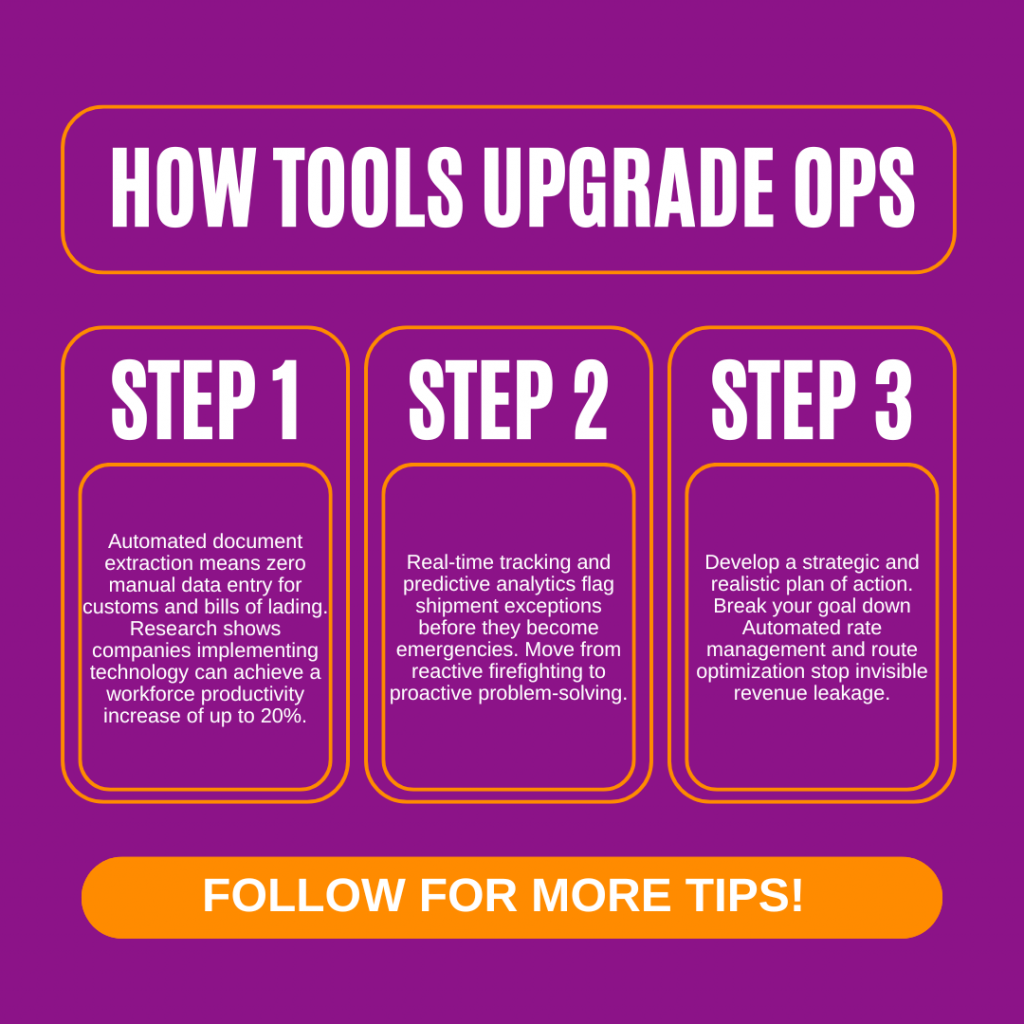
Automated document extraction means zero manual data entry for customs and bills of lading.
Manual document processing is error-prone, time-intensive, and creates bottlenecks during peak shipping periods. Optical Character Recognition (OCR) and AI-powered data extraction automatically populate customs declarations, bills of lading, and commercial invoices directly from source documents.
The Impact:
- 20% increase in workforce productivity (reallocating data entry time to client management)
- Reduced documentation errors that delay customs clearance
- Faster quote-to-shipment conversion times
Action Step: Audit your current documentation workflow. Identify which forms require manual rekeying of data already existing in email attachments or PDFs—these are your immediate automation targets.
2. Equip the Team with a “Crystal Ball”
Real-time tracking and predictive analytics flag shipment exceptions before they become emergencies.
Traditional freight forwarding operates reactively: A container gets rolled, then the team scrambles. A customs exam occurs, then the client is notified. Automation inverts this model to proactive management.
Capabilities:
- Predictive ETAs that account for port congestion and weather patterns
- Automated exception alerts when shipments deviate from planned routes
- Client notification triggers before they request updates
The Shift: Move from reactive firefighting to proactive problem-solving. When systems monitor continuously, humans intervene strategically.
3. Protect Profit Margins
Automated rate management and route optimization stop invisible revenue leakage.
Manual rate shopping and routing decisions often miss optimal combinations due to time constraints or data silos. Algorithmic rate management compares options across carriers, modes, and consolidation opportunities instantly.
Financial Impact:
- Up to 30% reduction in operational costs through optimized routing
- Elimination of cost-prohibitive manual errors in billing
- Automated margin protection through rule-based pricing applications
Key Takeaways: The Human-AI Collaboration Model
- 🔹 Automation Augments, Doesn’t Replace: AI handles data entry and tracking; humans handle negotiation and relationship management
- 🔹 Productivity Gains: Digital document processing increases workforce productivity by up to 20% by eliminating manual rekeying
- 🔹 Cost Protection: Supply chain digitalization reduces operational costs by up to 30% through rate optimization and error reduction
- 🔹 Proactive vs. Reactive: Real-time visibility shifts teams from crisis management to strategic exception prevention
- 🔹 The Trust Advantage: While systems manage containers, humans build the client relationships that create retention and growth
Frequently Asked Questions
Will AI replace freight forwarders and logistics jobs?
No. AI excels at data processing and pattern recognition but cannot perform relationship-dependent tasks like carrier negotiation during disruptions, customs crisis management, or strategic client consultation. Automation replaces manual tasks, not human expertise.
What is the difference between “grunt work” and “growth work” in freight forwarding?
Grunt work refers to repetitive, rule-based tasks like manual data entry, document processing, and status checking. Growth work encompasses high-value activities like route optimization, client relationship building, proactive exception management, and strategic business development.
How much can freight forwarding automation save?
Research indicates logistics automation can increase workforce productivity by up to 20% and reduce overall supply chain operational costs by up to 30%, primarily through error elimination, route optimization, and faster document processing.
What manual tasks should freight forwarders automate first?
Prioritize high-volume, low-complexity tasks: bill of lading data extraction, customs documentation population, container status checking, and rate comparison shopping. These create immediate time savings for reallocating to client-facing activities.
Implementation Checklist: Your 30-Day Automation Plan
- [ ] Week 1: Audit current documentation workflows to identify manual data entry bottlenecks
- [ ] Week 2: Evaluate automated document extraction solutions (OCR/AI data capture)
- [ ] Week 3: Implement real-time tracking dashboard with predictive exception alerts
- [ ] Week 4: Deploy automated rate management system to eliminate manual quote comparison
- [ ] Ongoing: Retrain operations team on proactive client communication protocols (using time saved from automation)
The Bottom Line
Let the system do the data entry; flawlessly.
Let the system track the container; instantly.
Let the human build the trust; constantly.
Freight forwarding automation isn’t a threat to operations teams—it’s the competitive advantage that allows them to focus on what algorithms cannot replicate: empathy, negotiation, and strategic partnership.
What is the ONE manual task your ops team wishes they could automate today? Share in the comments below—we read every response and use them to shape our roadmap.