TL;DR: With 76% of shippers experiencing disruptions and major crises hitting every 3.7 years, cheap freight rates offer false security. Supply chain sleep assurance shifts the value proposition from cost optimization to risk resilience ensuring your logistics operations protect manufacturing margins and stakeholder confidence even during blank sailings and port strikes.
The Hard Truth: Why “Cheap Freight” Is a Broken Value Proposition
We need to stop selling freight. And start selling sleep assurance.
I know your first thought: “But you’re an ocean freight company. How do you not sell freight?”
Here’s the data: 76% of shippers saw supply chain disruption last year. Major disruptions lasting over one month now hit every 3.7 years. When procurement teams optimize solely for rate per TEU, they inadvertently optimize for anxiety, stockouts, and 3 AM emergency calls.
Freight forwarders should optimize for peace of mind, not just cheap rates. That is where most supply chains are stuck—trading short-term savings for long-term vulnerability.
Key Insight: Logistics isn’t about containers anymore. It’s about making sure you don’t wake up in a cold sweat over a missing shipment.
What Is Supply Chain Sleep Assurance?
Supply chain sleep assurance is a logistics methodology that prioritizes predictability, resilience, and proactive risk management over unit cost minimization. It treats supply chain stability as a measurable service deliverable ensuring that disruptions don’t cascade into business continuity failures.
Unlike traditional freight forwarding focused on moving TEUs from Port A to Port B, sleep assurance provides layered contingency protocols and real-time predictability that protects manufacturing margins during exceptions.
The Sleep Assurance Trifecta: 3 Steps to Logistics Peace of Mind
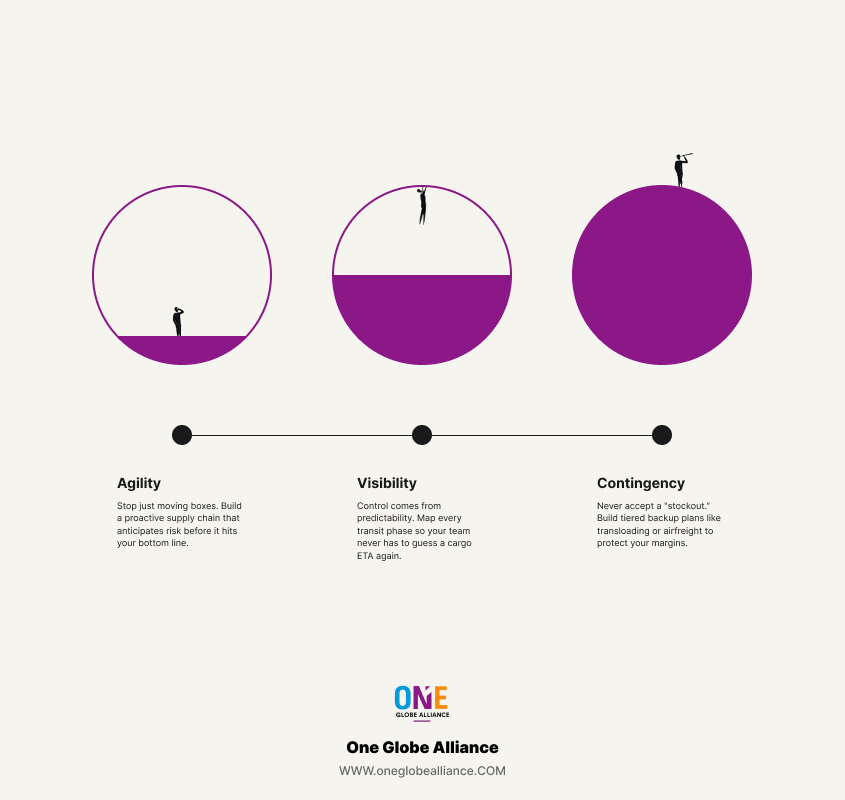
Step 1: Build an Agile Supply Chain (Not Just a Moving Service)
Challenge how your team handles risk, not just how they move containers.
Traditional procurement evaluates carriers on transit time and rate. Agile supply chain procurement evaluates partners on exception-handling capability, alternative routing networks, and crisis responsiveness.
The Mindset Shift:
- Old thinking: “Let’s hope it arrives on time.”
- Sleep assurance thinking: “We’re fully prepared for this blanked sailing.”
Agile supply chains maintain relationships with multiple carrier alliances, retain flexibility on port pairs, and view routing as dynamic optimization rather than static planning. When blank sailings or vessel rollovers occur, the system adapts without business continuity disruption.
Implementation: Audit your current carrier portfolio. If you rely on single alliance coverage for critical lanes, diversify immediately. Sleep assurance requires optionality.
Step 2: Structure Your Visibility Into Predictability
Visibility signifies control. Label every phase of transit to focus on predictability.
Container tracking is table stakes. Sleep assurance requires phase-based predictability breaking the transit process into discrete segments (pre-carriage, main haul, on-carriage, customs, final mile) with defined status gates and exception triggers.
The Mindset Shift:
- Old thinking: “How long until we get an ETA update?”
- Sleep assurance thinking: “I know exactly where our cargo is and what happens next.”
Phase-Based Framework:
- Pre-carriage: Booking confirmation → Container release → Gate-in
- Main haul: Loading → Departure → Transit milestones → Arrival window
- Post-arrival: Discharge → Availability → Customs status → Final delivery
Each phase carries specific predictability metrics. When stakeholders can trace cargo through these defined gates, uncertainty anxiety disappears—even when individual segments face delays.
Step 3: Own Multi-Tiered Contingency Plans (Not Just Plan B)
A single port strike shouldn’t mean a forever stockout. Maintain secondary logistics options.
Sleep assurance collapses when Plan A fails and no alternatives exist. Robust supply chains maintain tiered contingency protocols:
- Tier 1: Standard routing with primary carrier
- Tier 2: Alternative port pairs or transshipment options for minor delays
- Tier 3: Mode shift capabilities (transloading to airfreight, alternate origin consolidation) for critical disruptions
The Mindset Shift:
- Old thinking: “We need to halt production until this resolves.”
- Sleep assurance thinking: “This logistics team really protects our manufacturing margins.”
Example: When Shanghai port congestion hits, Tier 3 protocols might shift urgent cargo to Ningbo export via truck, maintaining delivery schedules despite origin disruptions.
Key Takeaways: From Cost Center to Assurance Provider
- 🔹 The Disruption Reality: 76% annual disruption rates and 3.7-year major crisis cycles make “cheap rates” a high-risk strategy
- 🔹 Agile Over Static: Build supply chains that adapt to blank sailings and rollovers, not just optimize for perfect-condition scenarios
- 🔹 Phase-Based Visibility: Structure tracking into discrete transit phases to create predictability, not just location data
- 🔹 Tiered Contingencies: Maintain three levels of backup plans so single-point failures don’t cascade into production halts
- 🔹 The Real Product: You’re selling manufacturing continuity and stakeholder confidence, not container space
Frequently Asked Questions
What is supply chain sleep assurance?
Supply chain sleep assurance is a logistics strategy that prioritizes risk resilience and predictability over unit cost savings, ensuring that supply chain disruptions don’t create business continuity emergencies or stakeholder anxiety. It combines agile procurement, phase-based visibility, and multi-tiered contingency planning to guarantee operational continuity.
How often do major supply chain disruptions occur?
Research indicates major supply chain disruptions lasting over one month now occur every 3.7 years on average, with 76% of shippers experiencing some form of supply chain disruption annually. This frequency makes reactive, cost-optimized logistics models operationally fragile.
How do you build an agile supply chain?
Build an agile supply chain by diversifying carrier alliances across multiple vessel-sharing agreements, maintaining flexible port-pair options for critical lanes, and evaluating logistics partners on exception-handling capability rather than just transit time and base rates.
What is the difference between visibility and predictability in logistics?
Visibility provides current location data (where the container is now). Predictability provides phase-based certainty about what happens next and when, creating proactive confidence rather than reactive tracking. Predictability requires defined transit phases with status gates and automated exception alerts.
How do contingency tiers work in supply chain management?
Contingency tiers provide escalating backup options: Tier 1 (standard primary routing), Tier 2 (alternative port pairs or transshipment for minor delays), and Tier 3 (mode shifts like airfreight or alternate origin points for major disruptions). This layered approach ensures no single failure point stops production.
Implementation Checklist: Your 90-Day Sleep Assurance Transition
- [ ] Week 1-2: Map critical lanes and identify single points of failure (sole carrier alliances, single port dependencies)
- [ ] Week 3-4: Negotiate secondary carrier relationships for primary trade lanes
- [ ] Week 5-6: Define phase-based transit milestones (pre-carriage, main haul, customs, final mile) with specific status gates
- [ ] Week 7-8: Implement predictive visibility technology with automated exception alerts at each phase
- [ ] Week 9-10: Document Tier 2 contingencies (alternative ports, transshipment options) for top 20% of volume lanes
- [ ] Week 11-12: Establish Tier 3 protocols (airfreight conversion, alternate origin points) for highest-priority shipments
- [ ] Ongoing: Quarterly “stress tests” simulating disruptions to validate contingency activation procedures
The Bottom Line
Change your resilience planning; often.
Show them the contingency options; clearly.
Stop tracking boxes, and guarantee some sleep.
When your board stops worrying about logistics and starts trusting it as a competitive advantage, you’ve successfully transitioned from freight seller to sleep assurance provider.
What is the one disruption keeping you up at night this year? Share in the comments below—our team monitors responses to identify emerging risk patterns across industries.