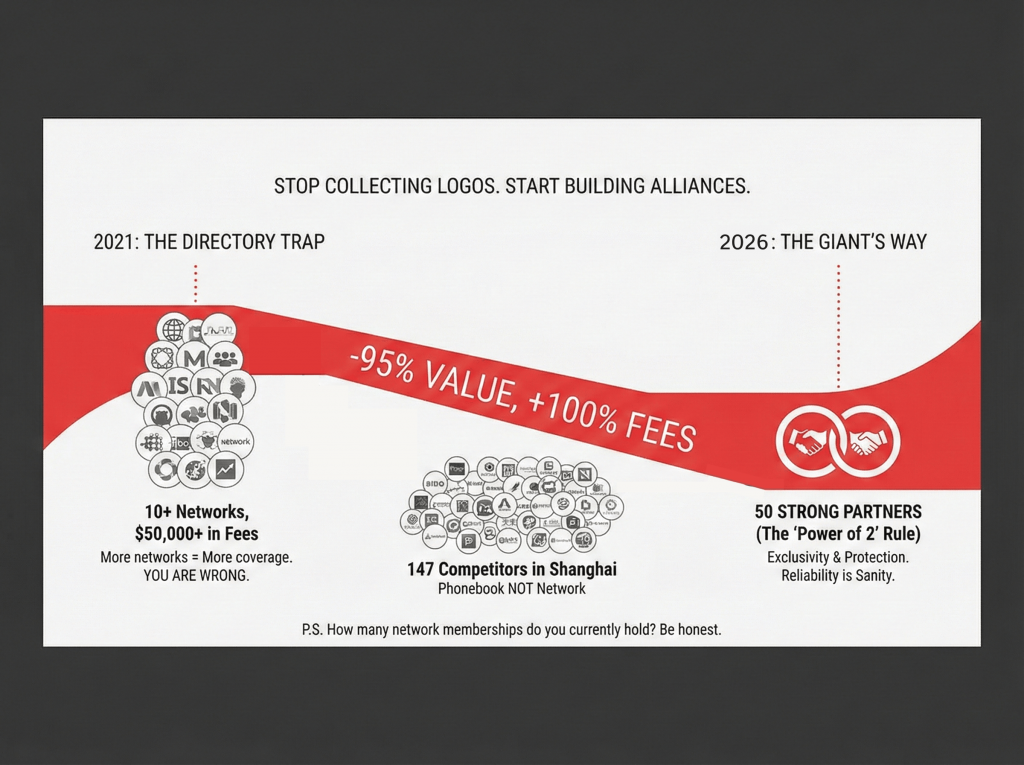
TL;DR: Independent forwarders waste thousands annually on “Global Networks” that function as expensive phonebooks—listing 147 competitors in the same city fighting for identical scraps. The “Directory Trap” prioritizes fee revenue over partner fit. Real network scalability follows the “Power of 2 Rule”: exclusivity (capped city membership) and protection (transparent financial protocols). You don’t need 10,000 generic contacts. You need 50 partners who will answer your call at 3 AM.
The January Mistake: Collecting Logos Instead of Alliances
We see forwarders making the same mistake every January. They renew memberships for 10 different networks.
The logic seems sound: More networks = More coverage. They are wrong.
This is what happens when a network chooses “fees” over “fit.”
The Scenario: You pay $5,000 to join a “Global Network.” You log in. You search for a partner in Shanghai. And you find 147 other members listed in the exact same city.
That isn’t a network. That is a phonebook.
And worse? You are listed next to 147 competitors who are fighting for the same scraps, driving rates down and service quality into the ground.
Key Insight: Density is vanity. Reliability is sanity.
The Giant’s Blueprint: How DHL and K+N Actually Structure Networks
The “Giant” multinational forwarders (DHL Global Forwarding, Kuehne+Nagel) don’t work this way. They don’t have 50 offices in one city fighting each other. They have one strong node—a single, fully-resourced office that owns that geographic market.
That office has:
- Dedicated capacity allocations
- Standardized service levels
- Direct financial backing from headquarters
- Exclusive territory rights (no internal competition)
If you want to scale like a giant, you need to think like one.
The independent forwarder advantage isn’t replication of the giant model—it’s curation. But curation requires exclusivity, not saturation.
The “Power of 2” Rule: Building Networks That Actually Answer at 3 AM
Real freight forwarder network value derives from two non-negotiable principles:
1. Exclusivity: Cap Membership or Cap Your Growth
If a network doesn’t limit membership in your city, you aren’t a partner. You’re a subscriber.
The Math:
- Saturated Network: 147 members in Shanghai → 0.68% theoretical “share” of network referrals, zero differentiation, race-to-bottom pricing on every inquiry
- Exclusive Network: 2-3 vetted members in Shanghai → 33-50% referral probability, trusted partner status, collaborative rather than competitive dynamics
Exclusivity transforms network membership from a marketing expense into a strategic asset. When you know you’re the only (or one of two) authorized representatives for that network in your city, you invest in the relationship. You answer the 3 AM calls. You prioritize their cargo.
2. Protection: Financial Transparency Over Bureaucracy
If the network’s financial protection plan has more red tape than a government office, it’s worthless.
Red Flags:
- Multi-layered claims processes requiring 6+ months for payment
- Opaque risk pools with unclear exposure limits
- No standardized credit protection or payment guarantees
- Complex arbitration clauses that favor the network headquarters over individual members
Green Flags:
- Direct financial protection (upfront credit limits, guaranteed payment within 30 days)
- Clear liability caps and insurance backing
- Simple, documented claims resolution (under 60 days)
- Transparent fee structures without hidden administrative costs
Protection isn’t about legal documents. It’s about knowing that when you move a shipment for a network partner, you will get paid—quickly, reliably, and without a forensic audit of your invoice formatting.
Key Takeaways: Network Strategy for Independent Forwarders
- 🔹 The Directory Trap: Networks listing 147 competitors in one city sell access, not partnerships—they’re expensive phonebooks, not strategic alliances
- 🔹 The Giant Model: Multinational forwarders use single-node cities (one strong office, not 50 fighting ones) to ensure capacity control and service consistency
- 🔹 Power of 2 Rule – Exclusivity: Demand capped city membership (2-3 partners max) or you’re paying to compete with your own network
- 🔹 Power of 2 Rule – Protection: Evaluate financial protocols, not just geographic coverage—guaranteed payment beats global reach if the reach is unsecured
- 🔹 The 3 AM Test: You don’t need 10,000 generic contacts. You need 50 partners who will actually answer your call during a crisis
- 🔹 ROI Reality: 1 exclusive relationship with guaranteed payment terms outperforms 10 directory listings with 147 local competitors
Frequently Asked Questions
What is the “Directory Trap” in freight forwarder networks?
The Directory Trap occurs when independent forwarders pay membership fees to global networks that prioritize revenue over partner quality, resulting in directories listing 100+ competing members in the same city. This creates a race-to-bottom pricing environment where no member achieves meaningful referral volume or partnership value.
Why is exclusivity important in freight forwarder networks?
Exclusivity (capping membership to 2-3 vetted partners per city) ensures that network referrals convert to actual business rather than competitive bidding wars. It transforms the relationship from transactional (who’s cheapest) to collaborative (who’s most reliable), incentivizing investment in partner success and 24/7 support availability.
How do DHL and K+N structure their office networks?
Major multinationals like DHL Global Forwarding and Kuehne+Nagel operate single-node cities—one fully-resourced office per geographic market with exclusive territory rights, standardized service levels, and direct financial backing. They avoid internal competition by design, creating concentrated capacity rather than fragmented market presence.
What is the “Power of 2 Rule” for freight networks?
The Power of 2 Rule states that effective forwarder networks must provide: (1) Exclusivity—capped membership per city (ideally 2-3 partners maximum), and (2) Protection—transparent, efficient financial protocols with guaranteed payment terms and minimal claims bureaucracy.
How many network memberships should an independent forwarder hold?
Quality trumps quantity. Most successful independent forwarders maintain 1-3 highly vetted, exclusive networks rather than 10+ directory memberships. The optimal number depends on your trade lane specialization—ensure you have redundant coverage for critical lanes, but avoid paying for overlapping, non-exclusive directories.
What makes a freight network “reliable” versus just “large”?
Reliability indicators include: exclusive territory rights (limited local competition), guaranteed payment protection (financial backing for member transactions), sub-60-day claims resolution, and 24/7 operational support availability. Large networks without these characteristics are merely high-cost directories.
Implementation Checklist: Audit Your Current Networks
- [ ] Membership Audit: List all current network memberships and annual fees paid
- [ ] Competition Mapping: Search your primary city in each network directory—if you see 50+ local competitors listed, you’re in a Directory Trap
- [ ] Exclusivity Verification: Confirm if your network caps membership in key trade lanes (Shanghai, Rotterdam, Mumbai, etc.) to 2-3 partners maximum
- [ ] Financial Protection Review: Request documentation on payment guarantee limits and average claims resolution timeframes (target: under 60 days)
- [ ] The 3 AM Test: Call your network partners at off-hours—record response rates and resolution quality
- [ ] ROI Calculation: Track actual revenue generated per network membership vs. annual fees and time invested
- [ ] Consolidation Plan: Identify 1-2 exclusive, high-protection networks to deepen rather than maintaining 5+ directory subscriptions
The Bottom Line
Stop collecting logos. Start building alliances.
You don’t scale by being listed in 10 directories alongside 147 competitors. You scale by being the exclusive, trusted partner in 3 cities who answers the phone at 3 AM and gets paid without a fight.
How many network memberships do you currently hold? Be honest. Drop the number below—let’s see who’s paying for vanity density versus investing in real reliability.