TL;DR: Maersk has sent the Cornelia Maersk back into the Red Sea, triggering “crisis over” headlines. But independent forwarders face a dangerous 3-5 month “transition chaos” period where loop switches leave containers stranded and routing remains unpredictable. One ship is a structural test, not a floodgate. Keep quoting Cape Route buffers through Q1, let major carriers be the guinea pigs, and sell certainty over speed—because clients pay for reality, not optimism.
The Headline vs. The Reality
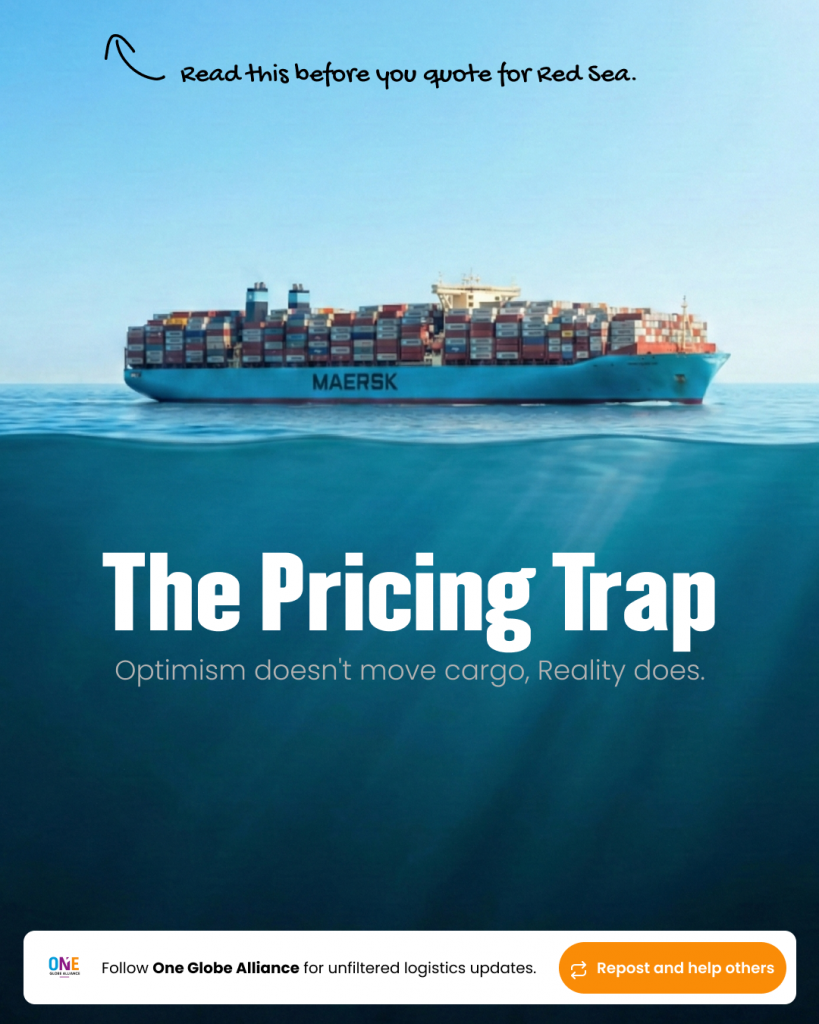
Maersk just sent the Cornelia Maersk back into the Red Sea.
The headlines say “Crisis Over.”
We say: Be careful.
It’s tempting to call your clients right now. To pick up the phone and shout: “Great news! Rates are dropping! Transit times are back!”
But here’s what the headlines aren’t telling you: the most dangerous phase of this crisis might be the transition back to “normal,” not the detour itself.
Key Insight: Your clients don’t pay you for optimism. They pay you for reality.
Why One Ship Doesn’t Equal “All Clear”
Three critical factors make this reopening a high-risk period for logistics operations:
1. It’s a “Structural Test,” Not a Floodgate
One ship is not a schedule. It’s an experiment.
The Cornelia Maersk re-entry is a controlled structural test to evaluate security conditions, transit viability, and operational safety. The risk remains massive—Houthi capabilities haven’t disappeared, and insurance markets remain skittish.
Reality Check: A single successful transit doesn’t clear the accumulated risk of 15+ months of disruptions. It merely tests whether the conditions for gradual re-entry exist.
2. The “Transition Chaos” Is Coming
When carriers switch loops from Cape routing back to Suez, containers get left behind.
The transition from Cape routing back to Suez might actually be messier than the detour itself. Here’s why:
- Equipment Imbalances: Thousands of containers are currently on the wrong side of the Cape (either stuck in Europe waiting for Asia-bound vessels, or vice versa)
- Schedule Fragmentation: Carriers must empty existing Cape loops while simultaneously rebuilding Suez strings—creating temporary service gaps
- Stranded Cargo: Shipments booked on Cape services may find their vessels suddenly reassigned to Red Sea routes (or vice versa), leaving cargo at transshipment hubs without clear onward routing
The Chaos Window: 4-8 weeks of operational confusion as the global fleet repositions.
3. Timelines Are Still Broken
It will take 3–5 months to reinstate full, reliable weekly schedules.
Even if the Red Sea reopens fully tomorrow, the ripple effects of 15+ months of diversions have shattered the regularity of liner networks. Vessel positioning, slot allocations, and port rotations require complete rebuilding.
What this means: Transit times quoted today based on “normal” Suez schedules may not materialize for quarters. Reliability will remain sub-70% through mid-2026.
The Independent Forwarder Risk: Quoting the Wrong Route
Why this matters to independent forwarders:
If you quote based on a Red Sea transit today…
And the ship diverts to the Cape tomorrow…
You eat the cost.
Or you lose the client.
The majors (Maersk, MSC, Hapag) can absorb a routing change. They have the balance sheets to eat the fuel difference and the client relationships to survive a delay notification.
Independent forwarders operate on thinner margins and higher trust coefficients. When you promise a 24-day transit via Suez and the vessel diverts around Africa for 38 days, you face:
- Rate exposure: Absorbing the cost differential between contracted and actual routing
- Client penalty clauses: Liquidated damages for late delivery in time-critical contracts
- Credibility damage: “You said it was over—why is my cargo still on the water?”
The Fix: Transition Strategy for Q1
Until the transition chaos resolves and weekly schedules normalize, independent forwarders should execute this defensive protocol:
Keep Quoting the “Cape” Buffer for Q1
Continue pricing and planning based on Cape of Good Hope transits through end of Q1 2026. If the Suez route materializes faster than expected, deliver early and capture the client delight. If it doesn’t, you’ve priced the reality, not the hope.
Let the Big Guys Be the Guinea Pigs
Allow major carriers to conduct the structural testing. Monitor the Cornelia Maersk and subsequent vessels for 30-45 days before adjusting your client quotations. The “wait and see” approach protects you from transition volatility.
Sell Certainty Over Speed Right Now
In uncertain transitions, clients pay premiums for predictability, not velocity. Position your value as:
- Guaranteed transit windows (even if longer) rather than optimistic shortcuts
- Proactive disruption management rather than reactive crisis calls
- Route transparency (“We’re monitoring the situation daily”) rather than false assurance
The Pitch: “We’re waiting for the majors to confirm stable Suez operations before routing your cargo that way. The 5 days you might save aren’t worth the 3-week delay if they divert back to the Cape mid-voyage.”
Key Takeaways: Navigating the Transition Chaos
- 🔹 One Ship ≠ All Clear: The Cornelia Maersk is a structural test, not a signal that the crisis has ended
- 🔹 Transition Chaos Ahead: Loop switches from Cape back to Suez will leave containers stranded and create 4-8 weeks of operational confusion
- 🔹 3-5 Month Recovery: Full, reliable weekly schedules won’t normalize until mid-2026 at the earliest
- 🔹 Quote Cape, Deliver Hope: Continue pricing Cape Route buffers through Q1 to avoid eating costs when vessels divert
- 🔹 Let Majors Test First: Independent forwarders can’t afford to be guinea pigs in a volatile security environment
- 🔹 Sell Certainty: In transition periods, reliability commands higher premiums than optimistic speed promises
Frequently Asked Questions
Is the Red Sea crisis over because Maersk sent a ship through?
No. Maersk sending the Cornelia Maersk through the Red Sea is a controlled structural test, not a full service reopening. Security risks remain elevated, and most carriers are maintaining Cape of Good Hope routing until conditions stabilize over weeks or months.
What is “transition chaos” in shipping?
Transition chaos refers to the operational disruption that occurs when carriers shift vessel loops from alternative routes (Cape of Good Hope) back to primary routes (Suez/Red Sea). This creates equipment imbalances, stranded containers, schedule gaps, and routing uncertainty lasting 4-8 weeks.
How long until Red Sea shipping returns to normal?
Industry estimates indicate 3-5 months to reinstate full, reliable weekly schedules through the Suez Canal, assuming security conditions remain stable. Transit time reliability will remain below normal levels through at least Q2 2026.
Should I quote Suez or Cape rates to clients right now?
Independent forwarders should continue quoting Cape of Good Hope transit times and rates through Q1 2026. This buffers against the risk of vessels diverting back to the Cape after quoting Suez transits, which would force cost absorption or client disappointment.
What happens to containers when carriers switch routes?
When carriers transition between Cape and Suez routes, containers often get “stranded” at transshipment hubs or left on the wrong side of the routing change. Equipment imbalances require weeks to resolve as vessels reposition to new loop structures.
How do I explain cautious routing to clients expecting “crisis over”?
Position your caution as risk management: “We’re monitoring the major carriers’ testing phase to ensure your cargo doesn’t face mid-voyage diversions. The stability of the route matters more than the speed right now.” Clients pay for certainty, not optimism.
Implementation Checklist: Q1 Transition Protocol
- [ ] Cape Buffer Quoting: Continue using Cape of Good Hope transit times (38-42 days Asia-Europe) for all Q1 2026 quotations
- [ ] Major Carrier Monitoring: Track Maersk, MSC, and Hapag announcements for 30-45 days before adjusting routing assumptions
- [ ] Client Communication: Proactively explain the “transition chaos” risk to clients requesting Suez routing—document the uncertainty
- [ ] Contract Protection: Ensure rate quotations include force majeure/routing change clauses through end of Q2 2026
- [ ] Equipment Positioning: Monitor container availability at Asian vs. European ports—transition chaos often creates shortages on one side
- [ ] Insurance Verification: Confirm war risk insurance remains valid for Red Sea transits before booking any Suez cargo
- [ ] Sell Certainty: Update sales collateral to emphasize reliability and proactive management over optimistic transit times
The Bottom Line
Don’t quote based on a headline. Quote based on the schedule.
The Cornelia Maersk re-entering the Red Sea is good news, but it’s not “mission accomplished.” The transition back to Suez routing creates more operational risk for independent forwarders than the Cape detour ever did.
Keep your buffers. Let the majors test the waters. And remember: your clients pay you to protect them from chaos, not to celebrate prematurely when chaos is still unfolding.
P.S. Are you advising clients to switch back yet—or are you waiting it out? Drop your strategy below. Let’s see who’s selling certainty and who’s selling hope.